
Solar illuminated house numbers promise zero trenching and zero drywall patching, yet generic retail plaques routinely disappoint homeowners by mid-December: right when darkness stretches to 14.5 hours and holiday deliveries peak, the plaque goes dark before 10:00 PM. That winter blackout is not inevitable—it is an engineering sizing problem with a straightforward math solution.
The December Solstice Energy Bottleneck
In June at 40° North latitude (Philadelphia, Columbus, Denver, Northern California), the sun climbs 73° high, delivering 5.5 to 6.5 Peak Sun-Hours (PSH) while night lasts barely 9 hours. By December 21, two compounding penalties hit simultaneously:
- Solar Input Drops by 65%–75%: The winter sun arcs only 26.5° above the southern horizon, days shrink, cloud cover rises, and horizontal peak sun-hours fall to 1.4–2.4 PSH in northern and Pacific Northwest states.
- Nightly Load Increases by 60%: Civil dusk-to-dawn runtime expands from 9 hours in summer to 14.0–15.0 hours in winter.
A tiny 0.8W horizontal amorphous-silicon strip glued flat onto the top edge of an address plaque harvests barely 0.9 Wh on a December afternoon—only enough energy to burn a 0.35W LED array for 2.5 hours!
Why 3.2V LiFePO4 Outperforms NiMH & Standard 3.7V Lithium-Ion
Outdoor address plaques endure extreme temperature swings directly against sun-baked masonry in August and sub-freezing wind chills in January. Battery chemistry dictates whether the sign survives past year two:
| Cell Chemistry | Nominal Voltage | Deep Cycle Life (to 80% SoH) | Sub-Freezing & High-Heat Stability | Real-World Replacement Interval |
|---|---|---|---|---|
| NiMH AA Pack | 1.2V / 2.4V | 300 – 450 cycles | High self-discharge in summer heat; sluggish cold charge | 12 – 18 months |
| Standard NMC 18650 Li-Ion | 3.7V | 500 – 700 cycles | Thermal degradation above 120°F; lithium plating below 32°F | 1.5 – 2.5 years |
| Lithium Iron Phosphate (LiFePO4 26650 / 32700) | 3.2V / 6.4V | 2,000 – 3,000+ cycles | Thermally stable to 140°F; flat discharge curve | 6 – 8+ years |
Winter Energy-Budget Sizing Formula
To guarantee full dusk-to-dawn legibility through three consecutive overcast December days without relying on hardwired 12V/24V Class 2 wiring, verify three hardware specs:
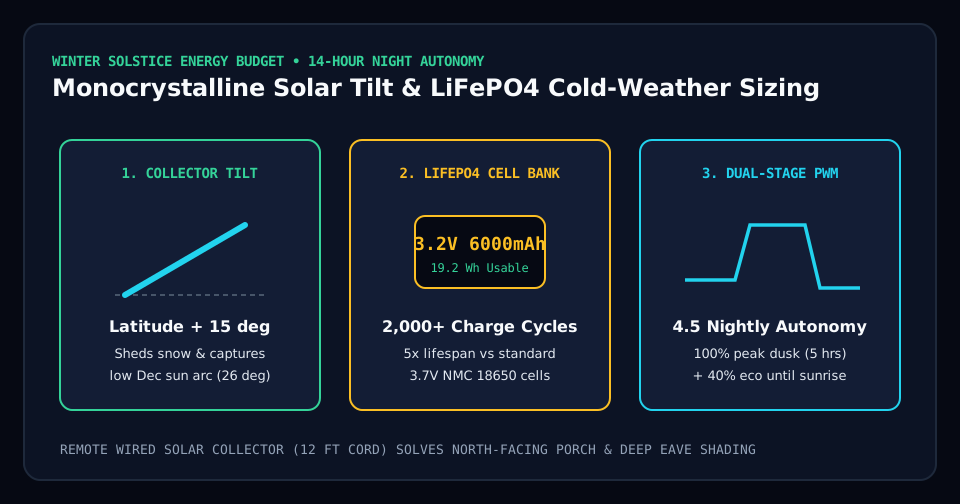
- Monocrystalline Collector Wattage & Tilt: Specify a tempered-glass monocrystalline panel rated at least 3.5W to 5.0W tilted at 45° to 55° (roughly
Latitude + 15°). That steeper angle intercepts low December sun rays nearly perpendicularly AND sheds wet snow rather than letting a half-inch crust block charging for a week. - Usable LiFePO4 Storage (≥ 16–20 Wh): A single 3.2V
6,000 mAh(19.2 Wh) LiFePO4 pack powering an efficient dual-stage LED controller (0.45Wduring prime 5:00 PM–11:00 PM evening hours, stepping down via PWM to0.18Wfrom 11:00 PM until sunrise =3.9 Whtotal nightly draw) delivers 4.5 full winter nights of cloudy-sky reserve autonomy. - Low-Temp Charge Protection BMS: In northern freeze zones, ensure the charge controller includes an NTC thermistor cutoff that pauses high-current charging below 32°F (0°C) until morning sun warms the cell above freezing, while still permitting uninterrupted LED discharge down to -4°F (-20°C).
Model your exact ZIP-code winter sun-hours, digit count, and continuous vs. motion-boost brightness profile in our Winter Sun-Hour & LiFePO4 Solar Autonomy Calculator on the homepage.
Need Driver Sizing or a Custom Halo Number Quote?
Preview your exact digits in our Live Kelvin & Standoff Halo Studio or send your cable distance and facade details to info@litnumbers.com.