
An illuminated address sign only protects emergency response times and evening deliveries if it turns on reliably every single night without someone remembering a wall switch. Because a four-digit LED address assembly draws just 8 to 12 watts—less than a single nightlight bulb—automating dusk-to-dawn operation costs roughly six dollars per year in electricity, provided you select a control strategy that avoids sensor feedback loops and seasonal sunset drift.
Why Mechanical Pin Timers Fail Twice Every Year
Legacy 24-hour mechanical dial timers force homeowners to chase sunset times across a three-hour seasonal swing—from 4:45 PM in December to 8:30 PM in June—plus two Daylight Saving Time resets and power-outage clock stalls. Modern installations replace fixed-clock timers with either an optical silicon photodiode relay or an in-wall / DIN-rail astronomical solar clock.
Option 1: Silicon Photodiode Dusk-to-Dawn Sensors
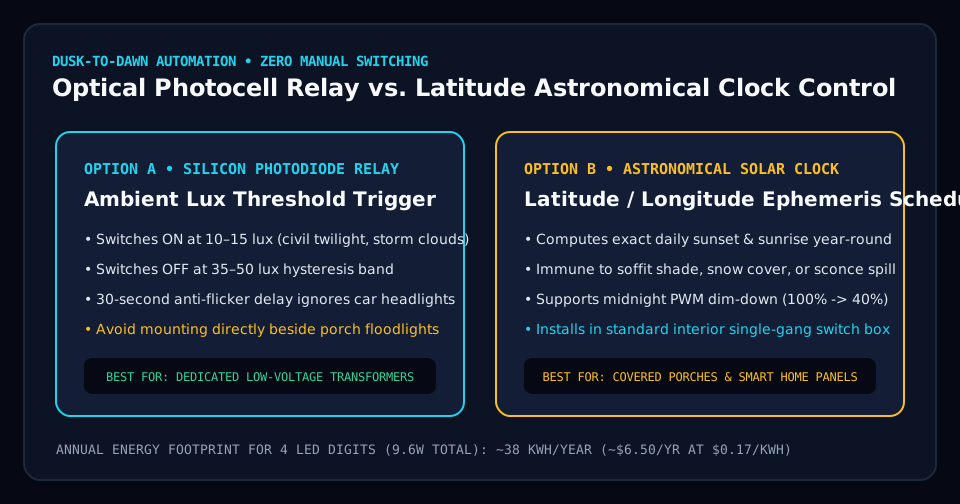
Modern filtered silicon photodiodes (which outlast older cadmium-sulfide CdS cells that drift upward in resistance after three summers of UV baking) measure real-time ambient sky illuminance in lux:
- Turn-On Threshold (10–15 lux): Activates automatically during civil twilight AND during dark afternoon thunderstorms or heavy wildfire/coastal marine overcast when street visibility drops early.
- Hysteresis Deadband (35–50 lux Turn-Off): By requiring 3× higher light to turn off than to turn on, plus a 30-to-60-second electronic time delay, quality photocells ignore passing high-beam headlights or lightning flashes.
Option 2: Latitude/Longitude Astronomical Switches
When your Class 2 LED driver sits indoors inside a garage utility closet, laundry room, or structured wiring enclosure—with zero exterior window access for a photocell wire—an astronomical timer switch (or smart Lutron Caseta / Shelly Pro relay) solves automation cleanly on the 120V AC primary side.
You enter your ZIP code or latitude/longitude coordinates once during setup. An internal ephemeris table calculates exact daily sunset and sunrise to the minute for all 365 days of the year, adjusts automatically for Daylight Saving Time, and retains timekeeping across power outages via a 10-year lithium coin cell or NTP Wi-Fi sync—completely immune to snow drifts, spiderwebs, or deep covered-porch shadows that trick optical eyes into burning at noon.
Control Architecture Comparison Matrix
| Control Method | Wiring Location | Storm / Fog Response | Midnight Dimming Support | Ideal Deployment Scenario |
|---|---|---|---|---|
| 12V/24V Inline DC Photocell | Secondary low-voltage line outdoors | Excellent (turns on in dark storms) | On/Off only | Tapping a constant-hot DC power bus near the facade |
| 120V Stem Photocell on NEMA 3R Driver | Outdoor transformer enclosure | Excellent (real-time sky lux) | Optional w/ dual-stage driver | Exterior side-yard low-voltage lighting transformer |
| In-Wall Astronomical Timer Switch | Interior single-gang 120V switch box | Scheduled (+/- offset from sunset) | On/Off or Dusk + Midnight Cut | Covered deep porches, shaded courtyards & snow climates |
| PWM Smart Dimmer + Astro Schedule | Low-voltage DC output (2–25 kHz PWM) | Scheduled + app/scene override | Full 10%–100% curve | High-LRV white stucco or Dark-Sky HOA neighborhoods |
Why PWM Dimming Beats Triac Dimming for Address Numbers
If your 3000K or 5000K halo numbers look slightly too bright against crisp white stucco at midnight—see our Kelvin & wall LRV photometry guide—adding a low-voltage DC Pulse-Width Modulation (PWM) dimmer (operating above 2 kHz for flicker-free phone video) between a non-dimmable Class 2 driver and the parallel digit manifold costs under twenty-five dollars and lets you dial halo intensity to the exact sweet spot (typically 55%–75% duty cycle). Alternatively, specify a UL Class 2 phase-dimmable driver paired with a compatible Lutron forward/reverse-phase wall dimmer so midnight scenes automatically step brightness down from 80% at 6:00 PM to 35% after 11:30 PM while preserving 911 curb legibility until dawn.
Need Driver Sizing or a Custom Halo Number Quote?
Preview your exact digits in our Live Kelvin & Standoff Halo Studio or send your cable distance and facade details to info@litnumbers.com.