
Homeowners ordering illuminated house numbers often spend hours debating character height while overlooking Correlated Color Temperature (CCT). Yet at night, the interaction between LED spectral output (measured in Kelvin) and your wall cladding's Light Reflectance Value (LRV) determines whether your address reads as a refined architectural halo or an overblown blue glare patch from 90 feet away.
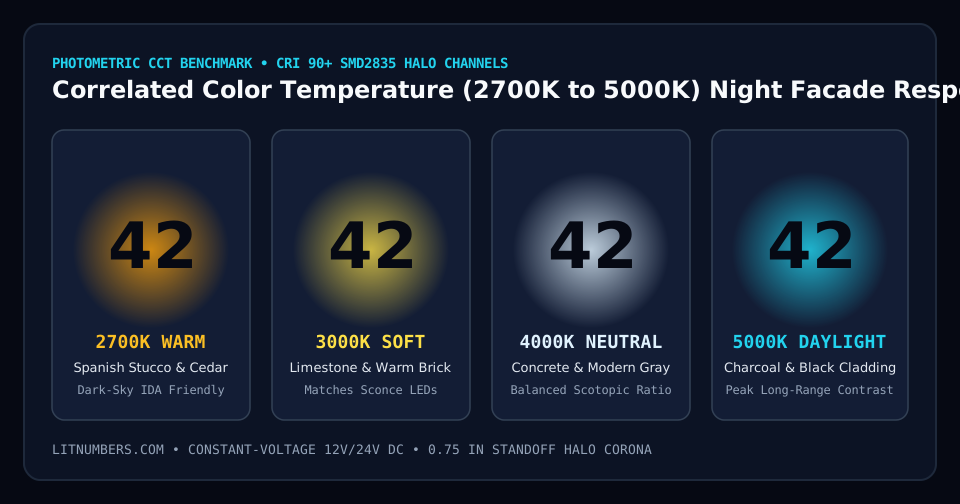
How Halo-Lit Contrast Actually Works on Nighttime Masonry
Unlike internally illuminated commercial box signs where the viewer looks directly through a translucent face, residential halo-lit (reverse-channel) numbers feature an opaque metal front shell—typically matte black anodized aluminum, brushed 316L stainless, or aged bronze—offset 0.50 to 1.00 inches off the facade. Light exits backward through a frosted cast PMMA acrylic diffuser, reflects off the wall texture behind the digit, and forms a luminous corona around the opaque stroke silhouette.
Because the human eye reads the dark numeral silhouette against the illuminated wall halo, two physical variables govern legibility at the street curb:
- Spectral Reflectance Matching: Warm iron-oxide red brick and western red cedar absorb short-wavelength blue light (450 nm) while reflecting warm amber-red wavelengths (580–630 nm). Putting a cold 6000K bluish LED on red brick wastes nearly half its reflected luminance and turns rich masonry a bruised purple-gray.
- Veiling Glare & Halation (Irradiation Illusion): If raw lumen density is too high on high-LRV white stucco (LRV 75–85), the bright halo bleeds inward across your retina, making a 0.65-inch numeral stroke look thin and blurry to delivery drivers and paramedics.
Photometric Selection Matrix by Cladding Material & Sconce CCT
| Wall Cladding & Finish | Typical Wall LRV | Recommended LED CCT | Target Flux per 6 in Digit | Optical Rationale |
|---|---|---|---|---|
| White / Ivory Santa Barbara Stucco | 72 – 84 | 2700K or 3000K | 90 – 130 lm | High wall reflectance amplifies halo spread; warm 2700K–3000K prevents harsh glare while matching entry sconces. |
| Kiln-Fired Red Brick / Terracotta | 18 – 28 | 2700K or 3000K (CRI 90+) | 150 – 210 lm | High R9 red-rendering index preserves warm clay tones instead of washing brick out into flat gray. |
| Clear Western Red Cedar / Ipe | 22 – 36 | 2700K Warm Amber | 140 – 190 lm | Harmonizes with natural wood grain and landscape path lights without attracting nocturnal insects. |
| Architectural Cast Concrete / Limestone | 45 – 60 | 3000K or 4000K | 120 – 170 lm | Neutral mineral surfaces support either warm residential 3000K or crisp modernist 4000K without color cast. |
| Charcoal Board-and-Batten / Black Slate | 7 – 14 | 4000K or 5000K (or Backplate) | 220 – 290 lm | Matte dark siding absorbs 85%+ of incident light; higher scotopic/photopic (S/P) ratio in 4000K–5000K recovers edge contrast, or pair with a contrasting pale sub-plaque. |
2700K Warm White: Dark-Sky Ordinances & Hospitality Warmth
Municipalities enforcing International Dark-Sky (IDA) outdoor lighting ordinances—including mountain communities in Colorado, Arizona, Utah, and coastal California—increasingly cap exterior residential luminaires at 3000K maximum (and often recommend 2700K). A 2700K LED emits minimal short-wavelength blue light, dramatically reducing skyglow scatter and nocturnal moth attraction around front entry doors.
3000K Architectural Soft White: The Residential Benchmark
Across custom home builds, 3000K CRI 90+ (3-step MacAdam ellipse / SDCM ≤ 3) is the most versatile specification. It reads noticeably cleaner and whiter than incandescent 2400K bulbs without crossing into commercial parking-lot chill. When paired with matte black aluminum faces on medium-tone stucco, travertine, or painted fiber-cement lap siding, 3000K delivers crisp 100-foot legibility while keeping residential curb appeal inviting.
4000K Neutral & 5000K Daylight: When Cool White Wins
Cooler 4000K and 5000K bins excel in three specific engineering scenarios:
- Contemporary Commercial & Medical Storefronts: Steel-and-glass facades already lit by 4000K linear grazing fixtures demand matching neutral white signage.
- Low-Albedo Dark Facades without Backplates: Under mesopic night vision (0.01 to 3 cd/m²), human rod photoreceptors peak near 507 nm (cyan-green). A 4000K or 5000K source has a scotopic-to-photopic (S/P) ratio of 1.65 to 2.05 compared with 1.15 for 2700K, making dim reflections off charcoal siding appear measurably brighter to peripheral and long-range vision.
- Dense Fog & Rain-Slicked Arterials: Where houses sit more than 100 feet from high-speed roads—see IFC Section 505.1 setback character-height sizing—pairing taller 8-inch or 10-inch numerals with 4000K edge-lit acrylic backplates maximizes contrast.
Standoff Gap Geometry: 0.50 in vs. 0.75 in vs. 1.00 in
Color temperature never acts alone; standoff spacer length controls how wide the halo spreads across the wall:
- 0.50-inch Standoff: Produces a tight, high-intensity razor outline ideal for smaller 4-inch and 5-inch digits where adjacent characters sit only 1.25 inches apart.
- 0.75-inch Standoff: The sweet spot for 6-inch to 8-inch residential numbers, blending individual SMD2835 emitter cones through a 3 mm frosted PMMA backplate with zero visible LED dotting.
- 1.00-inch Standoff: Creates a wide, soft architectural wash behind 10-inch to 12-inch estate numerals, provided neighboring digits are spaced at least 2.2 inches apart so halos do not merge into an unreadable blob around closed counters like
8,6, and9.
Use our interactive Live Kelvin & Standoff Halo Studio on the homepage to test your exact digits across 2700K–5000K and four wall LRV levels before ordering hardware.
Need Driver Sizing or a Custom Halo Number Quote?
Preview your exact digits in our Live Kelvin & Standoff Halo Studio or send your cable distance and facade details to info@litnumbers.com.