
Spend ten minutes reading buyer postmortems on bargain illuminated house numbers and a single failure pattern dominates: six to fourteen months after installation, half the segments in one digit go dark, brown rust streaks weep down white stucco, or frost swells the acrylic backplate off its glue joint.
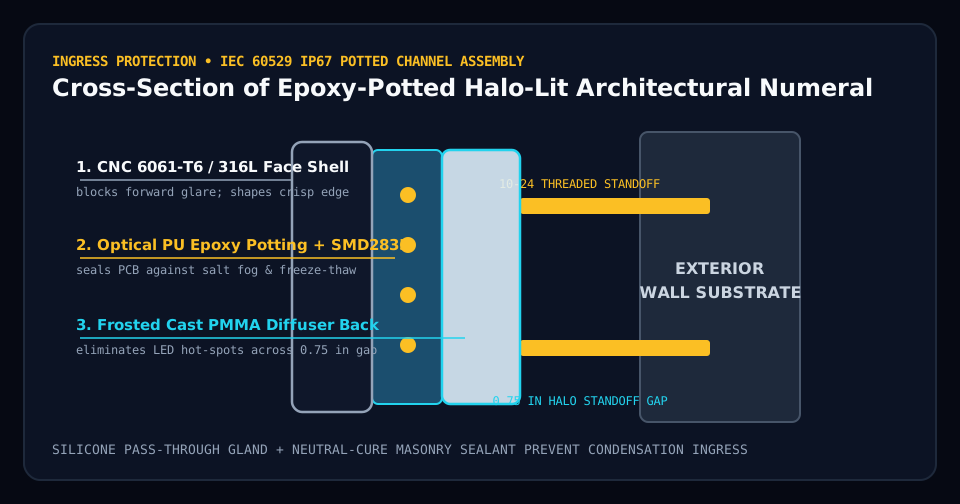
Why Hollow Gasketed Numbers Breathe Moisture (Thermal Pumping)
On a sunny January afternoon, a matte-black metal house number on a south-facing wall easily reaches 125°F (52°C), expanding the trapped air pocket inside a hollow channel housing. The moment a cold rain squall or sunset hits, internal air cools rapidly and creates a partial vacuum of 1.5 to 3.0 psi—literally sucking damp air and airborne road/ocean chlorides right past foam tape or thin silicone O-rings along the wire exit lead.
Once micro-droplets condense inside an unpotted PCB cavity, two destructive reactions accelerate:
- Electrochemical Dendrite Migration: Even at 12V DC, conductive moisture bridging positive and negative copper pads grows tin/copper dendrites within weeks, shorting individual 3-LED cut segments so half of a numeral
8or3goes dark. - Ice-Lens Delamination: Liquid water trapped between an aluminum shell and a glued acrylic backplate expands by 9% upon freezing, prying cyanoacrylate or VHB adhesive seams apart over 30–50 winter freeze-thaw cycles.
IEC 60529 Ingress Ratings & Potting Compounds Compared
| Construction Tier | Ingress Rating | Internal Cavity Architecture | Coastal / Snowbelt Lifespan | Primary Failure Mode |
|---|---|---|---|---|
| Hollow Channel + Peel-and-Stick Strip | IP44 – IP54 | Air cavity + adhesive LED tape on bare aluminum | 6 – 18 months | Tape peel under heat + solder pad corrosion |
| Gasketed Acrylic + Conformal Coat | IP65 | Thin acrylic spray over PCB + perimeter silicone bead | 2 – 4 years | Capillary wicking through stranded wire jacket |
| Solid Optical PU Resin Potting | IP67 / IP68 | Zero air void; vacuum-degassed aliphatic polyurethane | 8 – 12+ years (L70 > 50,000 hrs) | Gradual driver capacitor aging (replaceable indoors) |
Aliphatic Polyurethane vs. Standard Bisphenol Epoxy
Not all potting resins belong outdoors. Cheap aromatic bisphenol-A epoxies turn amber-yellow under UV exposure and cure rigid (Shore D 80+), cracking solder joints when aluminum expands twice as fast as FR-4 fiberglass PCBs across -20°F to +140°F swings. Specification-grade lit numbers use UV-stabilized aliphatic optical polyurethane or two-part platinum-cure optical silicone (Shore A 45–65), which stays compliant during thermal expansion while sealing every SMD2835 package and wire solder joint in a monolithic, void-free block.
Cast PMMA Acrylic vs. Polycarbonate Diffuser Backplates
The translucent rear lens of a halo-lit number handles two jobs: diffusing discrete LED points into a smooth glow and anchoring threaded mounting bosses.
- Cell-Cast PMMA (Polymethyl Methacrylate): Transmits 92% of visible light (when clear) or 78%–84% (when satin-frosted) and exhibits virtually zero UV yellowing over 10+ years outdoors. Always specify cell-cast rather than extruded acrylic so tapped
10-24orM5blind threads resist stress crazing. - Polycarbonate (Lexan): Offers higher impact resistance against vandalism on ground-level monuments, but requires a co-extruded UV cap layer; uncoated polycarbonate yellows noticeably within 36 months on sun-drenched facades.
Inspecting Build Quality Before Drilling Your Facade
Before boring a single hole in brick or stucco, flip the illuminated digit over and check four physical indicators: (1) zero visible air bubbles or exposed copper cut-pads on the rear surface, (2) a molded strain-relief grommet where the jacketed two-conductor lead exits the backplate, (3) solid threaded metallic inserts rather than shallow self-tapping plastic screws, and (4) UL Listed / Recognized Class 2 markings matching your transformer voltage. Pair durable hardware with proper parallel Class 2 manifold wiring so the indoor power supply is the only component you ever service a decade later.
Need Driver Sizing or a Custom Halo Number Quote?
Preview your exact digits in our Live Kelvin & Standoff Halo Studio or send your cable distance and facade details to info@litnumbers.com.